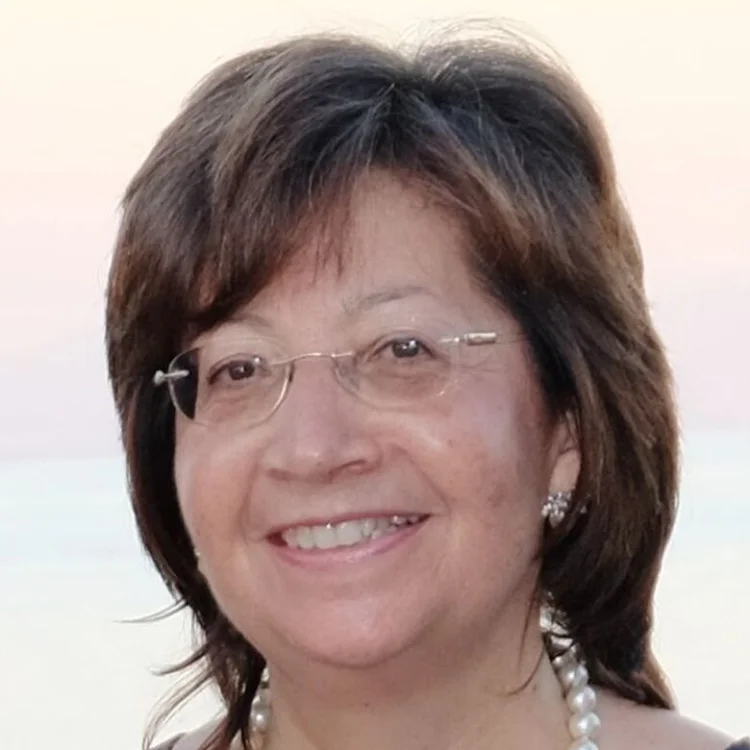
Role
Full Professor of General Physics at the Department of Physics, University of Rome Tor Vergata; Director of the INFN Rome Tor Vergata Section; member of the Teaching Board of the Doctorate in Physics.
Bio
After graduating in Physics in 1980 from Sapienza University of Rome, she continued her training at CERN and Brookhaven National Laboratory. Since 1984, she has been a researcher at the University of Rome Tor Vergata; after various periods of study and research abroad, she served as an associate professor from 1999 to 2013 and as a full professor from 2013 onwards at the same university. From 2015 to 2023, she directed the INFN section at Rome Tor Vergata.
His research focuses on high-energy physics through experiments conducted at CERN accelerators: R807 at the ISR, UA1 at the ppbar Collider, WA92 at the SPS proto-synchrotron, and, since 1992, the ATLAS experiment at the Large Hadron Collider. In this field, he has contributed significantly to the development of the RPC detectors for the muon spectrometer trigger.
Within the ATLAS Collaboration, she has held numerous senior positions, including on the Speakers Committee, the Publication Board, and the Collaboration Board's Advisory Board. She coordinated the Italian groups of the ATLAS experiment and was the national manager of the experiment from 2013 to 2015. Since 2017, she has also been collaborating on the upgrade projects for the muon spectrometer for the HL-LHC. She is a member of the executive committees of the European Physical Society and Science Europe and of the Equal Opportunities Committee of the Italian Physical Society.
She is the author of over 1,500 scientific publications. She received the SIF Award for Scientific Achievement in 1987, the European Physical Society Prize (HEPP Award) in 2013 together with members of the ATLAS Collaboration, the SIF Honorary Membership diploma in 2022, and the Breakthrough Prize in Fundamental Physics in 2025 together with members of the ALICE, ATLAS, CMS, and LHCb Collaborations.